When I first created this article, around 2013, my aim was to offer students at music conservatories and universities a guide to baritone saxophone repertoire suited to the technical and interpretative demands of Bachelor-level studies.
In later revisions (2015, 2017 and 2020), I introduced a number of changes, with a particular focus on original repertoire — or on published adaptations and versions made by the composers themselves. Repertoire is constantly evolving: new works continue to appear, and I am always discovering new ones myself. Check out this post to see what I mean. Over the years, I have therefore expanded this selection through other articles, where you will also find works suitable for Bachelor-level students: “15 More Works for Baritone Saxophone (1)” and “15 More Works for Baritone Saxophone (2)”.
Throughout this series, I have only included works that I have studied or performed at least once, with the aim of highlighting some of those I consider particularly interesting from both pedagogical and interpretative perspectives. Naturally, no one is better placed than your teacher to help you choose the works that are most suitable for you.
Here is my selection: 15 works for solo baritone saxophone, with piano, with electronics and in chamber music settings. I hope you find it useful!
![15 Advanced Works for Baritone Saxophone [1]](https://joanmf.com/wp-content/uploads/2020/09/15-Advanced-Works-for-Baritone-Saxophone-1.png)
1) Baritone Saxophone Solo
GEOMETRÍAS 1 (2003), Antonio Velasco
Edicions Clivis, Barcelona (ESP). Duration: ca 6:00
Range (written): A2 – Bb5
A very well-structured work combining several techniques commonly found in contemporary repertoire, including multiphonics, slap and transitional air sounds.
Watch the video!
More about GEOMETRÍAS 1
HENDIA (2002), Sixto Manuel Herrero Rodes
Rivera Editores, Valencia (ESP). Duration: ca 5:00
Range (written): Bb2 – C#6
A very interesting work for developing specific techniques such as multiphonics, voice integrated into the sound and articulation, as well as the expressive intensity required in performance.
Listen to the audio!
More about HENDIA
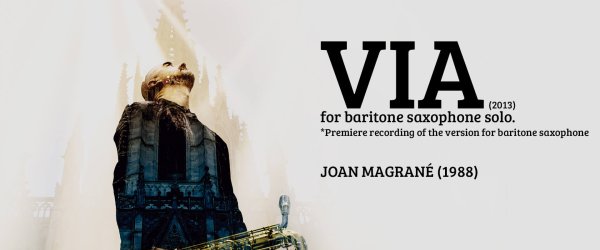
VIA (2013), Joan Magrané
Contact the composer (joan.magrane@yahoo.es). Duration: ca 10:00
Range (written): A2 – F#5
The original version, for baritone saxophone, requires a good command of slap, as well as specific stage work for reciting the Latin text indicated in the score.
Listen to the audio!
More about VIA
DREAMLOVER (2017), Albena Petrovic
Contact the composer (superalbalonga@gmail.com). Duration: ca 7:30
Range (written): Bb2 – F5 (or as high as possible).
A distinctive work for its use of the feet, integrated into the musical discourse, which also requires a good command of vocal effects and a highly expressive and, to some extent, theatrical interpretation.
Listen to the audio!
More about DREAMLOVER
2) Baritone Saxophone and Electronics
CON CADENCIA DE ETERNIDAD (1989/2002), José Manuel López López
Contact the composer (mariasanchezlucas@gmail.com). Duration: 9:00. Fixed electronics.
Range (written): A2 – D5 (higher with multiphonics)
A very interesting work for exploring a wide range of extended techniques (multiphonics, tukusonies, etc.), including improvisation, all integrated into a highly expressive musical discourse and in constant dialogue with particularly evocative electronics.
Watch the video!
JACKDAW (1995/2004), Wayne Siegel
Contact the composer (www.waynesiegel.dk). Duration: 10:23. Fixed electronics.
Range (written): Bb2 – G5
This work requires great precision and agility in articulation, intervallic leaps and register changes, as well as careful coordination with the electronics.
Listen to the audio!
More about JACKDAW
PIMPIN’ (2007-08), Jacob Ter Veldhuis
Boombox Holland (NDL). Duration: 8:32. Fixed electronics.
Range (written): A2 – E6
One of the best-known and most appreciated works in the baritone saxophone repertoire. This relentless funk gives the performer no respite and is also highly demanding technically.
Watch the video!
More about PIMPIN’
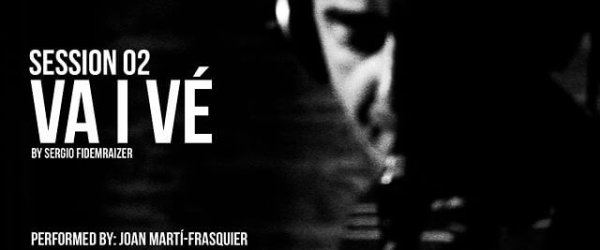
VA I VE (2010), Sergio Fidemraizer
Editions Bar&Co, Ambazac (FRA). Duration: 6:05. Fixed electronics.
Range (written): A#2 – E6
An intense and highly expressive work featuring a range of extended techniques (multiphonics, slap, growls, etc.), together with theatrical elements that also make it particularly fun to perform.
Watch the video!
More about VA I VE
3) Baritone Saxophone and Piano
SONATA Op. 6 (ed. 1976), Garland Anderson
Southern Music Company, San Antonio (USA). Duration: ca. 12:30
Range (written): Bb2 – F5
A good example of American modal neoclassical music, originally written for this instrumentation, and a good choice for students taking up the baritone saxophone during their Bachelor-level studies.
More about SONATA Op. 6 by Garland Anderson
TROIS POUR DEUX (1982), Jeanine Rueff
Editions Combre, Paris (FRA). Duration: ca. 9:00
Range (written): A2 – G5
Originally written for baritone saxophone and piano, this work features a constant rhythmic interplay between the two instruments, together with numerous expressive contrasts in its melodic writing.
Watch the video!
More about TROIS POUR DEUX
SONATE (2010), François Blot
Editions Bar&Co, Ambazac (FRA). Duration: ca. 11:00
Range (written): A2 – C#6
A very interesting work both for the technical demands it places on the baritone saxophone and for the precision and ensemble coordination required with the piano.
SONATA (2017), Gustavo Britos Zunín
Contact the composer (gjbritos@gmail.com). Duration: ca. 12:00
Range (written): A2 – C6
A good example of original repertoire for baritone saxophone and piano written in a post-Romantic style, without the need to resort to transcriptions. Highly expressive, it also requires close coordination between the two instruments.
More about SONATA by Gustavo Britos Zunín
4) Chamber Music with Baritone Saxophone
Chamber music with baritone saxophone goes far beyond the saxophone quartet. For this reason, I have chosen to highlight other instrumental combinations that allow students to explore different possibilities of the instrument and broaden their chamber music repertoire.
BLACK (2008/11), Marc Mellits
For two baritone saxophones (originally for two bass clarinets)
Marc Mellits / Dacia Music (ASCAP). Duration: ca. 5:00
Range (written): A2 – A4 (1st baritone) / A2 – F#4 (2nd baritone)
An exciting and fun work for two baritone saxophones, written in a minimalist, repetitive style that requires great rhythmic precision between the two performers.
Watch the video!
More about BLACK
FALW (1990), Patrice Sciortino
For baritone saxophone and percussion (cymbals, temple blocks and toms; one percussionist)
Éditions Alphonse Leduc, Paris (FRA). Duration: ca. 7:00
Range (written): A2 – F#5
An interesting and technically accessible duo that nevertheless requires careful coordination between the saxophone and percussion.
MEGADONT (2012), William Dougherty
For three baritone saxophones
Babel Scores. Duration: ca. 8:00
Range (written): D#3 – A#5 (1st, 2nd and 3rd baritones)
A good example of contemporary music that explores the timbral possibilities of the baritone saxophone through the interaction between the three instruments. I think that performing the work with the three saxophonists surrounding the audience could add a particularly effective spatial dimension.
Watch the video!
More about MEGADONT
Ready to choose?
I hope this article has shown you that the baritone saxophone has a wealth of original repertoire that is both pedagogically valuable and well suited to Bachelor-level students. Exploring and performing this repertoire can help you find your own path as a performer, far beyond the saxophone quartet.
Focusing on original works does not mean rejecting transcriptions. As saxophonists, we also need to explore music written before the invention of our instrument in order to develop the broadest possible musical background. But we cannot keep looking only to the past: we must also discover, perform and promote our own repertoire and, whenever possible, help expand it by encouraging the creation of new works.
This is how I have built a large part of my artistic career.
If you have any questions about anything discussed in this article or would like to share your own experience with the instrument, please feel free to contact me.
Joan Martí-Frasquier
Baritone saxophonist, contemporary music performer and professor of saxophone.
Barcelona
Updated: 22 August 2026