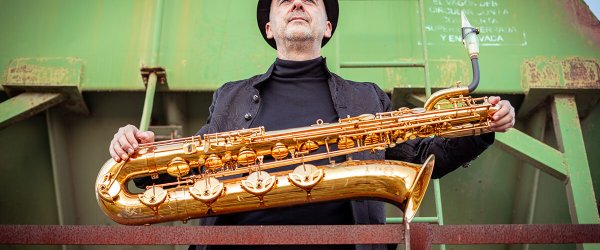
In an article about getting started on the baritone saxophone, I explained why I think the intermediate years of music education can be a good time to start playing the baritone. Alongside individual lessons, wind bands or other instrumental ensembles and chamber music (for example, playing in a saxophone quartet) are ideal settings to discover the instrument and become familiar with its particular characteristics.
But the baritone saxophone repertoire goes much further. There are works you can perform in recitals at your conservatoire or music school, either solo or with piano… and, if you feel adventurous, with electronics. Why not? Electronics opens up a whole world of sonic possibilities, and the works I suggest in this selection are varied and enjoyable.
When I created the first version of this article, around 2013–2014, I wanted to offer students and teachers a guide to baritone saxophone repertoire suitable for this stage of musical training. The works included here are pieces I know well, not only because I have studied or performed them myself, but also because I have worked on some of them with my students.
Here is my selection of 15 works for solo baritone saxophone, baritone saxophone and piano, and baritone saxophone with electronics, arranged chronologically within each category. Check with your teacher to decide which works are most suitable for you.
I hope you find it useful!

1) Baritone Saxophone Solo
MAKNONGAN (1976), Giacinto Scelsi
Editions Salabert (1986), Paris (FRA). Duration: ca. 4:00
Range (written): E3 – F#4
This work for any low-pitched instrument is an excellent introduction to contemporary music and Scelsi’s highly distinctive musical language. It allows you to explore different tone colours and focus on breath control, with circular breathing as an optional further step.
Watch the video!
EL SUR (1997), Adolf Ventas
Unpublished. Duration: ca. 9:30
Range (written): C3 – A5
A highly representative work by saxophonist, composer and arranger Adolf Ventas. Its three movements reveal the influence of Spanish music from the late 19th and early 20th centuries, alongside French modal music from the first half of the 20th century.
Listen to the audio!
More information about EL SUR
SOLITUDINI (2012), Enric Riu
Contact the composer (enricriu@yahoo.es). Duration: ca. 4:00
Range (written): Bb2 – Db5
Originally written for baritone saxophone, this short and intense work is a good introduction to some techniques commonly found in contemporary music, such as multiphonics and bisbigliando, while also requiring careful control of dynamics.
Listen to the audio!
More information about SOLITUDINI
SIX SHORT PIECES (2014), Greg Bartholomew
Burke & Bagley, Seattle (USA). Duration: ca. 6:30
Range (written): A2 – B5 (optional C6)
A good example of American modal neoclassical music. The six short pieces, each with its own distinctive character, provide opportunities to work on articulation, phrasing and expressive contrasts within a conventional musical language.
ONE MORE LAST TIME (2015), Nick Russoniello
Contact the composer (https://www.nickrussoniello.com.au/store). Duration: ca. 4:30
Range (written): A2 – E5
An engaging work that combines slow, expressive passages with faster, more rhythmic ones, in a musical language influenced by tango and pop-rock.
Watch the video!
Five works, five different ways to discover the baritone: exploring sound and listening with Scelsi, other 20th-century musical languages with Ventas, an introduction to extended techniques with Riu, phrasing and articulation with Bartholomew, and an introduction to more popular musical influences with Russoniello.
2) Baritone Saxophone and Piano
FANTAISIE, OP. 60 (ca. 1858), Jean-Baptiste Singelée
Roncorp Publications, Inc. (USA). Duration: ca. 3:30
Range (written): C3 – Bb4
Probably one of the very earliest original works for baritone saxophone and piano, written in the Classical-Romantic style of the period. A great opportunity to discover the instrument’s historical repertoire.
Watch the video!
FANTAISIE ORIGINALE POUR SAXOPHONE BARYTON ET PIANO (1877), Louis Mayeur
Gallica Editions. Duration: ca. 4:00
Range (written): B2 – Eb5
Another original work from the historical repertoire for this instrumentation, alternating lyrical and expressive passages with faster, more virtuosic ones, in a style characteristic of much 19th-century chamber music for saxophone.
PRELUDE ET DIVERTISSEMENT, Robert Clérisse
Éditions Gérard Billaudot, Paris (FRA). Duration: ca. 3:30
Range (written): C#3 – D5
Although this work was not written specifically for baritone saxophone —it is also commonly performed on alto or tenor saxophone—, it is a good choice for working on a wide variety of articulations.
ROMANCE (1988), Cesar Giovannini
Southern Music Company, Texas (USA). Duration: ca. 4:30
Range (written): E3 – D5
A lyrical work particularly well suited to developing musical expression, phrasing and the baritone saxophone’s rich tone colours.
CANTO MÍSTICO (2006), Santiago Báez
Contact the composer (santibaez1982@hotmail.com). Duration: ca. 3:30
Range (written): C4 – D#5
A highly expressive original work, ideal as a first introduction to the repertoire for baritone saxophone and piano.
PA’L BARI (2008), Fernando Lerman
Contact the composer (ferlerman@gmail.com). Duration: ca. 5:00
Range (written): A2 (optional) – F#5
Originally written for jazz quartet, Fernando Lerman later adapted it for baritone saxophone and piano. It is a brilliant work with demanding rhythmic writing, a wide variety of articulations and fast passages, based on the chacarera, a traditional Argentine dance.
Watch the video!
Six works to discover the variety of baritone saxophone and piano repertoire: from some of the very earliest original works of the 19th century by Singelée and Mayeur to more recent musical languages, while exploring articulation, phrasing, expression and tone colour along the way. And even an Argentine chacarera with Pa’l Bari!
3) Baritone Saxophone and Electronics
ALAS DE SEDA (1996), Juan Manuel Cortés
Contact the composer (jmcortes2@movistar.es). Duration: ca. 6:00. Fixed electronics.
Range (written): C3 – F#5
A good work for getting started with electronics that also gives you the opportunity to practise switching between the two extremes of the saxophone family: baritone in the first and third movements and soprano in the second and fourth, if you decide to perform the complete work.
18 (2009), Joan Arnau Pàmies
Editions Bar&Co, Ambazac (FRA). Duration: 7:20. Fixed electronics.
Range (written): Db3 – C5
An ideal work for getting started with electronics and exploring different saxophone timbres through improvisation, within the immersive atmosphere created by the electronic part.
Listen to the audio!
More information about 18
AIRE (2009), Andrés Lewin-Richter
Periferia Sheet Music. Duration: 9:12. Fixed electronics.
Range (written): Bb2 – G5
A good introduction to both repertoire with electronics and contemporary music, using a conventional musical language that also incorporates some extended techniques, such as slap tonguing.
SHEROW MUSTERY BAR (2011), Xavier Parlant
Self-edited (xavier.parlant@laposte.net). Duration: 4:40. Fixed electronics.
Range (written): A2 – B5
Not all music with electronics has to be contemporary or experimental. The disco and pop influences in this work might even have you dancing while you play.
Watch the video!
More information about SHEROW MUSTERY BAR
Four very different ways to start discovering music with electronics: switching between baritone and soprano, improvising and exploring new timbres, introducing some extended techniques or simply letting yourself be carried away by disco and pop rhythms. As you can see, electronics can be a lot of fun!
Continue Exploring the Repertoire
I hope this article has shown you that the baritone saxophone has a wealth of original repertoire that is both pedagogically interesting and suitable for intermediate-level students. The variety of styles and musical languages in this selection will allow you to discover different possibilities of the instrument while also introducing you to contemporary music and electronics in an enjoyable way.
If these 15 works have sparked your curiosity, take a look at my other repertoire selections, where you will also find works suitable for intermediate-level students: “15 More Works for Baritone Saxophone (1)” and “15 More Works for Baritone Saxophone (2)”.
If you have any questions about the topics covered in this article or would like to share your experience with the instrument, feel free to contact me.
Joan Martí-Frasquier
Baritone saxophonist, performer specialising in contemporary music and saxophone professor.
Barcelona
Updated: 23 August 2026
![15 Advanced Works for Baritone Saxophone [2]](https://joanmf.com/wp-content/uploads/elementor/thumbs/15-Advanced-Works-for-Baritone-Saxophone-2-ra3ttwqci012qs6fqnu49f7x6h6nihiw6j1idodd50.png "15 Advanced Works for Baritone Saxophone [2]")