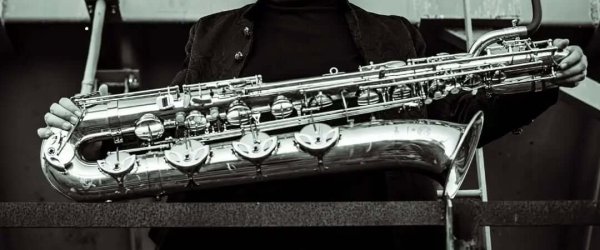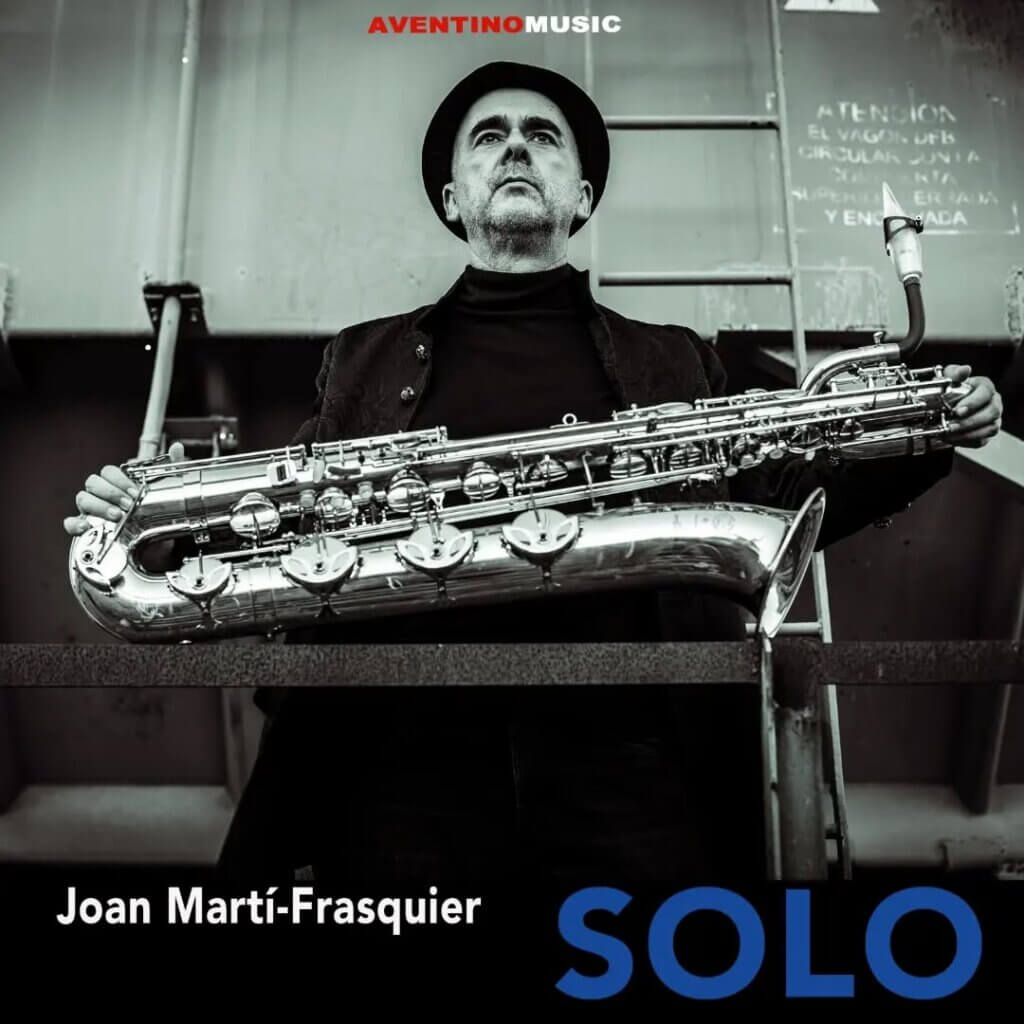
Cover of the album
I am pleased to present to you this new album for Italian label Aventino Music Avant-Garde. This is my 5th solo album, already. In this post, I tell you something about it!
CREDITS
Produced by Joan Martí-Frasquier Music
Aventino Music Executive Producer: Claudio Scozzafava
Recorded at Auditori Josep Carreras, Vilaseca (Spain) on 14 February 2025
Recording & Editing: Sixto Cámara Moya
Mastering: Dario Giuffrida
Cover Picture: Daniel Miguel
℗ & © 2025 Aventino Music – Avant-Garde Series (AM-AG-011)
Produced in Italy
https://www.aventinomusic.com/
https://www.aventinomusic.com/experimentis/
THE ALBUM
In November 2023, Claudio Scozzafava proposed me to record for the contemporary music line of his label. I was delighted to have this opportunity because I beard very attractive recording projects in mind.
We decided to record first a solo album to let you appreciate the rich and wide sound palette of the baritone saxophone. We thought that SOLO (a musical composition for an unaccompanied voice or instrument) would be a good title for this album.
Since we have plans to make other recordings in the future, we agreed to make a shorter one for now. That’s why we have included three pieces in very different styles, which will show you the great versatility of the baritone saxophone. One of the works is original for the instrument, other one does not specify which saxophone it was composed for, and one was originally written for voice. Of these three pieces, two are premiere recordings.
The baritone saxophone, with a range quite similar to the cello or the bassoon, does not only work as the harmonic and rhythmic base in music bands, ensembles or saxophone quartets. In the mid-20th century, several jazz saxophonists (Serge Chaloff, Pepper Adams or Gerry Mulligan, among others) had no complexes about using it as the lead voice of their groups, because of the malleability and expressive capabilities of the baritone.
In classical/contemporary music, recognition as a solo instrument came later and more slowly. At the end of the 20th Century, we start finding relevant works in our repertoire such Margoni’s Sonata or Havel’s Oxyton. The more and more frequent collaboration between performers and composers has grown the production of new repertoire. Nowadays, the baritone has a prominent role within the saxophone family.
THE REPERTOIRE
ADOLF VENTAS (1919-2014): EL SUR (1997) for saxophone solo
- Embrujo
- Martinete
- Zapateado
ISABEL BENITO (b. 1981): QUASI UNO SPECCHIO (2020) for baritone saxophone solo
GIACINTO SCELSI (1905-1988): THREE LATIN PRAYERS (1970) for voice solo
- Ave Maria
- Pater Noster
- Alleluja
EL SUR, Adolf Ventas
Adolf Ventas (Amposta, Catalunya, Spain, 1919 – Barcelona, Catalunya, Spain, 2014) was a prolific performer, teacher, composer and arranger. Ventas, as a composer, intended to enlarge and promote the original repertoire for saxophone. He spread the instrument into the Spanish classical music scene, where it still was a perfect unknown. Most of his original works are a particular blend between the music by Spanish composers as Albéniz and Granados and the modal music by French composers as Messiaen. Ventas’ music sounds fresh, without excessive artifice. His slow movements are deep and expressive and the fast ones are vigorous and brilliant. El Sur (1997) is a good example. You will clearly notice it in the evocative Embrujo, the noble Martinete, and the lively Zapateado.
Read more about this work here: https://joanmf.com/el-sur-adolf-ventas/
QUASI UNO SPECCHIO, Isabel Benito Gutiérrez
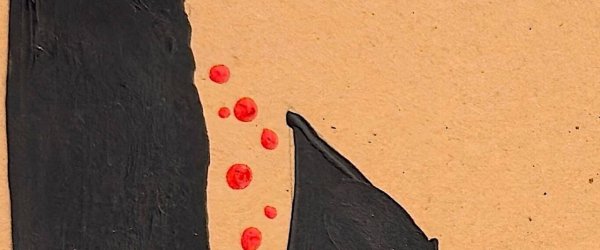
Isabel Benito Gutiérrez (Santander, Spain, 1981) posed a very interesting question to me: how to transcribe the typical gestures and lines of painting to the sounds of the baritone saxophone. Conventional music notation not always give a clear idea to performers. Sometimes, as in the case of Quasi uno Specchio (2020), a line, a point, a color or a symbol have a much greater power of suggestion. Presented as a graphic score, the composer doesn’t ask to always repeat the work with the same precision and accuracy. She prefers to letting the performer express him/herself. After all, the message always remains.
Read more about this work here: https://joanmf.com/quasi-uno-specchio-isabel-benito-gutierrez/
THREE LATIN PRAYERS, Giacinto Scelsi
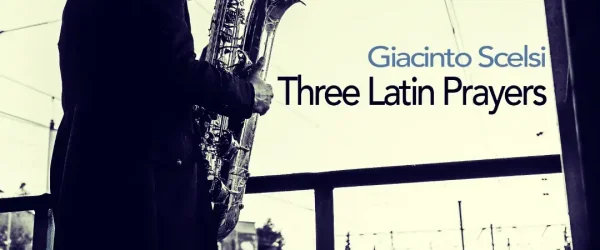
Giacinto Scelsi (La Spezia, Italy, 1905 – Rome, Italy, 1988) has always seemed to me a fascinating composer. His best-known musical production shows the strong influence of the spirituality of Eastern cultures. We can hear a great amount of timbral colorations on one or a few notes with complex microtonal inflections that are modified with the use of articulations, dynamics, pitch, etc. However, in these Three Latin Prayers (1970) Scelsi seemed to have turned towards Western spirituality, by using three of the main prayers from the Christian liturgy: Ave Maria, Pater Noster and Hallelujah. Although being originally composed for solo voice and given his few production for saxophone, I thought that these pieces could be suitable for saxophone, an instrument very close to the voice.
Read more about this work here: https://joanmf.com/three-latin-prayers-giacinto-scelsi/
—
I hope you like this album.
Joan Martí-Frasquier
Barcelona, December 2025